

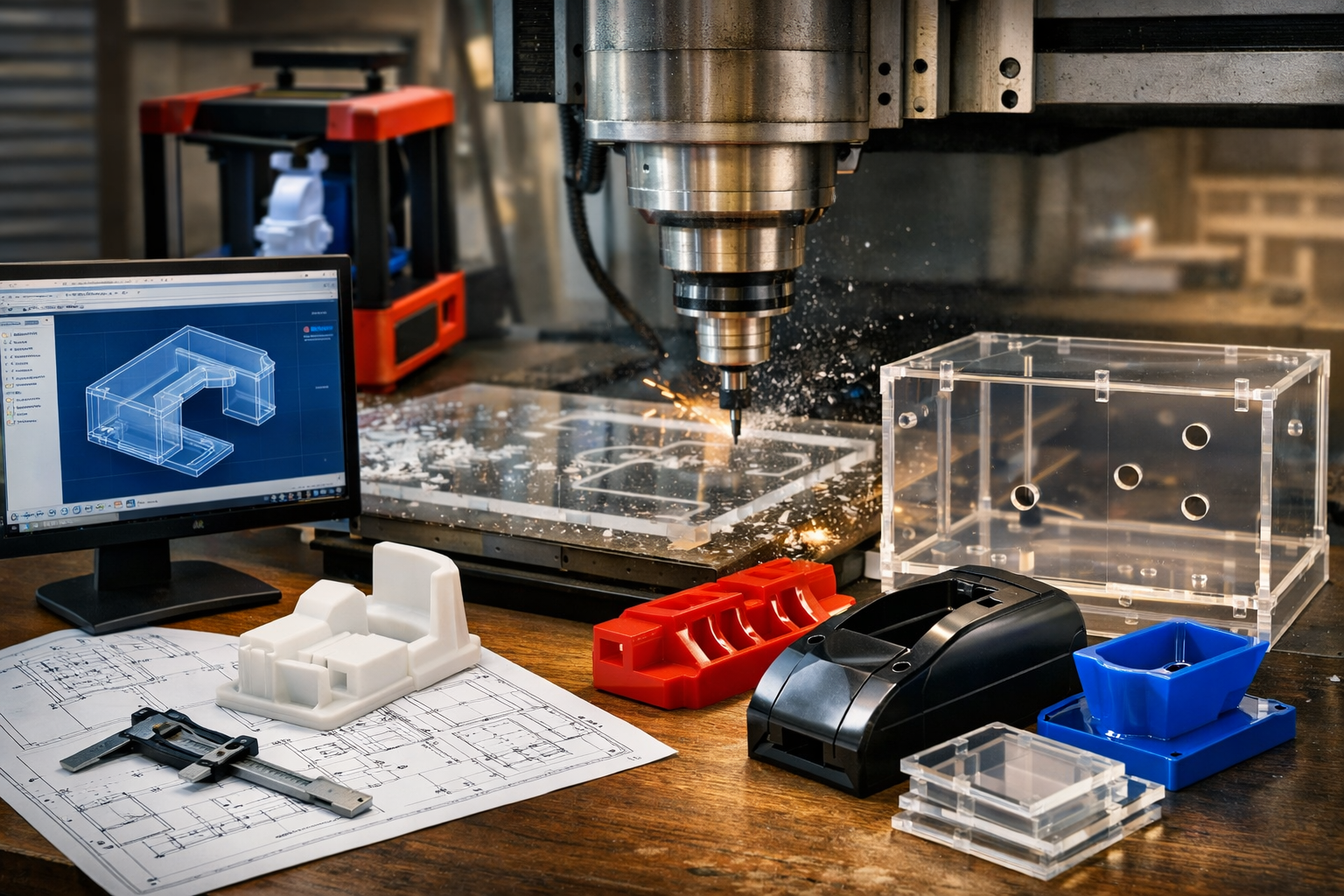
For manufacturers, product developers, contractors, and other businesses in Orem, turning a plastic component from an idea into a finished part involves more than choosing a material and cutting it to size. Design decisions, fabrication methods, tolerances, quantities, and intended use can all affect the final result.
Custom plastic fabrication provides a practical path from early prototypes to repeatable production parts. For businesses along the Wasatch Front, understanding that process can make it easier to plan a project, communicate specifications, and avoid unnecessary redesigns.
Quick answer: Custom plastic fabrication is the process of creating plastic parts, components, displays, enclosures, and other products to project-specific dimensions and requirements. A project may move through design review, material selection, prototyping, fabrication, finishing, and production. The right approach depends on the part’s application, geometry, tolerances, material requirements, and quantity.
What local businesses should know
- A prototype can help identify fit, dimensions, and design issues before committing to a larger production quantity.
- Material selection should be based on the actual environment and function of the finished component, not appearance alone.
- Businesses in Orem and the surrounding Utah County manufacturing corridor may need anything from one-off components to repeat production runs.
- Providing drawings, measurements, quantities, and application details can make the fabrication process more efficient.
- Production planning should account for both how a component will be fabricated and how it will ultimately be assembled or installed.
Why Does Custom Plastic Fabrication Matter in Orem?
Custom plastic fabrication matters in Orem because local businesses often need components made for a specific application rather than a standard, off-the-shelf product. From product development and equipment components to retail fixtures and specialized assemblies, custom fabrication allows dimensions, materials, and features to be matched to the actual project.
Orem sits within a broader Utah County business and manufacturing region that includes Provo, Vineyard, Lindon, Pleasant Grove, and American Fork. Interstate 15 also connects area companies with suppliers, customers, and operations throughout the Wasatch Front.
For a local company, that means a plastic fabrication project may be part of a new product, a replacement component, a piece of equipment, a display, or an ongoing production requirement.
D&D Plastics works with customers seeking custom plastic fabrication solutions. We can approach each project according to its individual specifications rather than assuming every plastic component requires the same process.
How Does the Custom Plastic Fabrication Process Work?
The custom plastic fabrication process typically moves from defining the part and selecting an appropriate material through prototyping, fabrication, finishing, and production. Establishing the requirements early helps ensure that the fabrication method and material are suited to the component’s intended function.
A typical project can include several stages.
1. Define the application. Start with what the finished component needs to do. Its environment, dimensions, loads, appearance, exposure, and interaction with other components can influence later decisions.
2. Review the design. Drawings, dimensions, CAD information when available, and physical samples can help communicate the desired result. The design should also account for how the plastic can realistically be fabricated.
3. Select the material. Different plastics have different characteristics. Material choice may depend on factors such as rigidity, impact resistance, chemical exposure, transparency, temperature, machinability, or appearance.
4. Create a prototype when appropriate. A prototype provides an opportunity to evaluate fit and function before moving into larger quantities.
5. Fabricate and finish the component. Depending on the design, fabrication can involve cutting, machining, forming, joining, drilling, routing, polishing, or other processes.
6. Move into production. Once the design and specifications are established, the project can transition toward the required production quantity.
What Should Orem Businesses Know About Plastic Material Selection?
Plastic material selection should begin with the component’s real operating conditions because different plastics respond differently to impact, temperature, chemicals, loads, and environmental exposure. Choosing solely by price or appearance can create problems if the material does not match how the finished part will actually be used.
For an indoor component in an Orem facility, requirements may be very different from those of a part exposed to Utah’s outdoor conditions. Temperature swings, sunlight, installation location, cleaning chemicals, repeated handling, and mechanical stress may all matter.
Questions worth answering before selecting a material include:
- Will the component be used indoors or outdoors?
- Does it need to be clear, translucent, or opaque?
- Will it encounter chemicals or cleaning agents?
- Is impact resistance important?
- Will the part experience repeated loads or movement?
- Does appearance matter on the finished surface?
- Will it be machined, formed, bonded, or mechanically fastened?
There is no single plastic that is automatically best for every application. Matching material properties to the actual use is the more reliable approach.
Why Is Prototyping Valuable Before Plastic Production?
Prototyping is valuable because it allows a design to be evaluated before additional time and material are committed to production. A prototype can reveal issues involving dimensions, clearances, mounting points, assembly, accessibility, appearance, or overall function that may not be obvious from a drawing alone.
This can be particularly useful for Utah County businesses developing new products or modifying existing equipment.
A prototype does not necessarily need to duplicate every characteristic of a final production component. Its purpose should be defined in advance. One prototype might be intended primarily to confirm dimensions, while another may need to evaluate actual fit and function.
That distinction helps determine what should be tested before the project advances.
What Warning Signs Suggest a Plastic Part Needs Redesign or Replacement?
Warning signs that a plastic component may need redesign or replacement include recurring cracks, poor fit, deformation, excessive wear, damaged mounting areas, repeated failures, or difficulty obtaining the original part. These symptoms can indicate either normal service wear or a mismatch between the component’s design, material, and application.
Watch for:
- Cracking around holes, corners, or fasteners
- Warping or permanent deformation
- Repeated breakage in the same location
- Excessive surface wear
- Loose or misaligned mounting points
- Poor fit with mating components
- Discoloration or deterioration after environmental exposure
- An obsolete component that is difficult to source
A failed part should not automatically be copied without considering why it failed. In some situations, reproducing the exact design can reproduce the same problem.
When Should You Work With a Professional Plastic Fabricator?
You should work with a professional plastic fabricator when a project requires precise dimensions, specialized fabrication, material guidance, repeatable parts, or a transition from prototype to production. Professional input is particularly useful when fabrication decisions can affect fit, assembly, durability, or production consistency.
Simple plastic sheets can sometimes be measured or modified in-house. More complex components may require equipment and processes that are not practical for a general maintenance shop or product team.
For Orem businesses, it can be helpful to involve a fabricator before a design is considered completely final. Early discussion can identify fabrication considerations while changes are still easier to make.
What Common Factors Cause Custom Plastic Parts to Fail?
Custom plastic parts commonly fail because of material mismatch, stress concentration, improper dimensions, environmental exposure, or a design that does not reflect actual operating conditions. Determining the cause is important because replacing a failed component with an identical copy may only restart the same failure cycle.
Material mismatch: A material may lack the characteristics required for the application.
Stress around holes or fasteners: Mounting and assembly details can create concentrated loads.
Unexpected temperature or environmental exposure: Conditions inside a facility may differ substantially from outdoor installations around Utah Valley.
Dimensional problems: Small dimensional errors can affect fit, alignment, or assembly.
Changes elsewhere in the equipment: A component that worked with an original assembly may no longer fit correctly after other parts have been modified.
The better starting point is understanding the failure before determining the replacement approach.
How Can Businesses Prepare for a Custom Fabrication Project?
Businesses can prepare for custom fabrication by gathering accurate dimensions, drawings, samples, quantity requirements, application details, and information about the component’s operating environment. Better project information helps reduce ambiguity and gives the fabricator a clearer picture of what the finished component needs to accomplish.
Before discussing a project, consider documenting:
- Overall dimensions and critical tolerances
- Hole and mounting locations
- Required quantity
- Intended use
- Indoor or outdoor exposure
- Temperature or chemical exposure
- Desired appearance
- Assembly requirements
- Whether an existing sample is available
- Whether the project is a prototype or established production part
For companies around Orem, Provo, Lindon, and the rest of Utah County, preparing this information can also make it easier to compare possible fabrication approaches.
What Results Can You Expect From Custom Plastic Fabrication?
Custom plastic fabrication can produce components tailored to specific dimensions, functions, materials, and quantities, provided the project requirements are clearly defined and technically achievable. The outcome depends heavily on the design, chosen material, fabrication method, tolerances, and information supplied at the beginning of the project.
A successful prototype phase should provide useful information for the next decision. That may mean approving the design, making revisions, changing a feature, or reconsidering a material.
Production is not simply “more prototypes.” Once a component will be made repeatedly, consistency and repeatability become increasingly important considerations.
What Mistakes Should Orem Companies Avoid?
Orem companies should avoid treating custom plastic fabrication as simply cutting a plastic shape because material behavior, tolerances, fastening, finishing, and production quantity can all affect the finished component. Planning these factors early can prevent avoidable revisions later in the project.
Mistake: Choosing material based only on cost.
Consequence: The material may not suit the operating environment.
Better approach: Evaluate the application’s mechanical and environmental requirements first.
Mistake: Skipping the prototype on an untested design.
Consequence: Fit or assembly issues may appear after multiple parts have been made.
Better approach: Consider validating critical dimensions and functions before production.
Mistake: Providing incomplete measurements.
Consequence: Important assumptions may have to be made about the design.
Better approach: Identify critical dimensions, mounting locations, and mating components.
Mistake: Copying a repeatedly failed component without investigation.
Consequence: The replacement may develop the same failure.
Better approach: Examine the failure location, operating conditions, and material before finalizing the replacement.
What Does a Common Orem Plastic Fabrication Project Look Like?
A common Orem plastic fabrication scenario begins when a business needs a component that cannot be conveniently purchased in the required dimensions or configuration. The customer may have a drawing, an existing part, or simply a functional requirement that needs to be translated into a fabricatable component.
This is a common scenario, not a D&D Plastics case study.
For example, a local operation might have an existing plastic component that is worn, obsolete, or unsuitable for a modified piece of equipment. The process could involve documenting the required dimensions, evaluating the intended environment, selecting an appropriate fabrication method, producing an initial part, checking fit, and then determining whether additional quantities are needed.
That progression illustrates why communication at the beginning of the project matters.
What Custom Plastic Fabrication Solutions May Be Available?
Custom plastic fabrication solutions may include prototyping, cutting, machining, forming, joining, finishing, and production of project-specific components, depending on the design and a fabricator’s capabilities. The exact combination should be determined by the geometry, material, quantity, tolerance requirements, and intended use of the finished part.
At D&D Plastics, we can discuss the requirements of a custom project and determine what information is needed to evaluate the next step.
How Do Prototype and Production Fabrication Compare?
Prototype and production fabrication serve different purposes: prototyping focuses on validating a design, while production focuses on creating the required quantity with repeatable specifications. A project may need both stages, especially when a component is new, complex, or dependent on precise interaction with other parts.
| Consideration | Prototype | Production |
|---|---|---|
| Primary goal | Evaluate the design | Produce required quantities |
| Design changes | Usually easier to incorporate | Ideally minimized |
| Quantity | Typically limited | Multiple parts or ongoing needs |
| Focus | Fit, function, and validation | Repeatability and consistency |
| Best use | New or revised components | Established specifications |
The appropriate path depends on the maturity of the design. A well-established replacement part may have different needs from a completely new product concept.
What Areas Can Custom Plastic Fabrication Support Around Orem?
Custom plastic fabrication can support businesses throughout Orem and the surrounding Utah County area when projects require application-specific plastic components. Nearby communities include Provo, Vineyard, Lindon, Pleasant Grove, and American Fork, with the broader Wasatch Front connected through the regional transportation and business corridor.
Project requirements should determine the fabrication approach regardless of where within the local service area the finished component will be used.
What Can Happen If a Fabrication Problem Is Ignored?
Ignoring a fabrication problem can lead to repeated component replacement, equipment downtime, assembly difficulties, material waste, or additional redesign work. The exact consequences depend on the component, but recurring cracking, deformation, poor fit, or premature wear usually deserves investigation rather than repeated replacement without identifying the cause.
For an area business, even a relatively small component can become significant when it affects a larger assembly or interrupts normal operations.
Addressing the underlying design, material, or fabrication issue early can provide better information for the next replacement or production decision.
Frequently Asked Questions About Custom Plastic Fabrication
What is custom plastic fabrication?
Custom plastic fabrication is the creation or modification of plastic components according to project-specific requirements. Depending on the component, the work can involve processes such as cutting, machining, forming, joining, drilling, and finishing. The appropriate process depends on the material, geometry, tolerances, quantity, and intended application.
Can an Orem business start with just a prototype?
Yes, an Orem business can begin with a prototype when the goal is to test a new or revised component before considering larger quantities. The prototype stage can help evaluate dimensions, fit, assembly, and function, giving the project team useful information before specifications are finalized for production.
What information should I provide for a custom plastic part in Orem?
Provide the clearest specifications available, including dimensions, drawings, quantities, application details, material requirements if known, and information about the operating environment. For an Orem project involving an existing component, a physical sample may also provide useful context, particularly when the original drawings are unavailable.
How do I choose the right plastic material for a Utah County application?
Choose a plastic material by matching its properties to the component’s actual use. Consider mechanical loads, impact, temperature, chemical contact, indoor or outdoor exposure, appearance, and fabrication requirements. Utah County’s outdoor temperature and sunlight exposure can also be relevant when a component will not remain in a controlled indoor environment.
Should a damaged plastic component simply be copied?
Not always. A damaged component can provide useful dimensional information, but the reason for its failure should also be considered. If cracking, deformation, or wear occurred repeatedly, reproducing the exact design and material could reproduce the problem. Evaluating the application first may identify factors worth addressing.
Is custom plastic fabrication only for large production quantities?
No. Custom plastic fabrication can be relevant to prototypes, individual replacement components, limited quantities, and production work. Whether a particular project is practical depends on its design and fabrication requirements. Businesses around Orem should communicate the expected quantity early because quantity can influence how a project is approached.
Why are tolerances important in custom plastic fabrication?
Tolerances define how much dimensional variation is acceptable in a finished component. They become particularly important where a plastic part must fit another component, align with mounting points, or function within an assembly. Identifying truly critical dimensions can help an Orem-area project communicate functional requirements more clearly.
When should a Provo or Orem company involve a fabricator?
A Provo or Orem company should consider involving a fabricator while the design can still be adjusted, particularly for new or complex components. Early discussion can help identify material, geometry, and fabrication considerations before specifications become difficult or costly to change.
Move Your Orem Plastic Project From Idea to Finished Part
A successful custom plastic fabrication project starts with understanding the application, defining the requirements, and choosing a practical path from design or prototype to the required production quantity. We focus on helping customers clarify what their plastic component needs to accomplish before moving forward.