

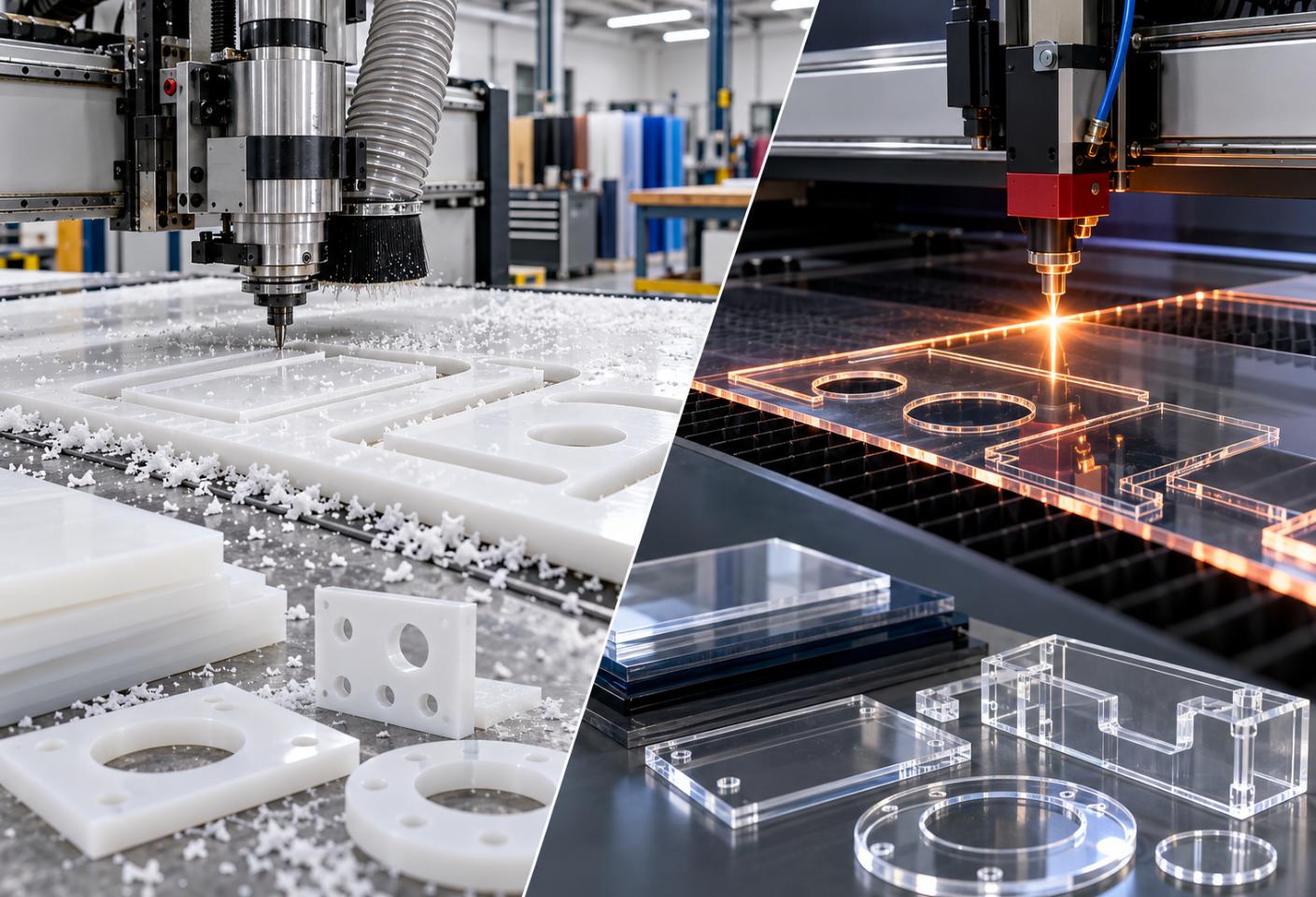
Choosing the wrong plastic cutting method can turn a promising design into a costly production problem. For businesses, manufacturers, and contractors in Orem, UT, the difference between CNC routing and laser cutting can affect part accuracy, material performance, edge quality, and overall project costs.
Whether you’re developing a custom equipment component, creating an acrylic display, or ordering replacement plastic parts, understanding these two methods helps you make a better fabrication decision.
Quick answer: CNC routing is generally the better choice for thicker plastics, complex machined features, and materials that do not respond well to laser cutting. Laser cutting is often ideal for intricate two-dimensional designs, detailed patterns, and smooth edges on compatible materials such as acrylic. Neither process is automatically more accurate or cost-effective. The best choice depends on your material, thickness, design, tolerances, and intended application.
What local readers should know
-
CNC routing uses a rotating cutting tool to shape plastics, while laser cutting uses a focused beam of energy.
-
Orem manufacturers often need precise holes, slots, and mounting features that make CNC routing especially useful.
-
Businesses in Provo, Lindon, and Vineyard can benefit from laser cutting for compatible acrylic signage, displays, and decorative components.
-
Material thickness, edge appearance, production quantity, and part complexity influence the best cutting method.
-
Choosing the correct process before production can reduce material waste, rework, and assembly problems.
For businesses throughout Utah County, precision plastic fabrication supports everything from equipment protection and manufacturing operations to retail displays and custom product development.
At D&D Plastics, we offer CNC routing, laser cutting, and custom plastic fabrication services. We help customers evaluate material properties, design requirements, and project goals so they can choose an appropriate fabrication approach.
What Is the Difference Between CNC Routing and Laser Cutting?
The primary difference between CNC routing and laser cutting is how each process removes material. CNC routing mechanically cuts plastic with a rotating tool, allowing for profiles, holes, grooves, and recessed features. Laser cutting uses concentrated heat to follow programmed paths, making it particularly useful for intricate shapes in compatible sheet materials.
How CNC routing works
A computer-controlled router moves a rotating cutting bit along programmed paths to shape plastic material. Different cutting tools and machining strategies allow the process to produce both flat profiles and more complex features.
CNC routing is commonly used for:
-
Thick plastic sheets and industrial components
-
Equipment guards, panels, and enclosures
-
Precise mounting holes and slots
-
Pockets, grooves, and recessed areas
-
Custom replacement parts and prototypes
For Orem manufacturers developing functional plastic components, CNC routing provides flexibility when a design requires more than a simple outline.
How laser cutting works
Laser cutting directs a focused beam onto compatible plastic material, separating it through controlled heating. The process can produce detailed shapes without physical contact between a cutting bit and the material.
Laser cutting is particularly useful for:
-
Acrylic signs and decorative panels
-
Intricate lettering and detailed patterns
-
Custom retail display components
-
Thin, flat plastic profiles
-
Designs requiring narrow cuts and small features
For customer-facing projects near University Place or Utah Valley University, laser-cut acrylic can provide clean edges and detailed visual elements.
What Do Material Properties Tell Us About Cutting Performance?
Material properties are one of the strongest indicators of whether CNC routing or laser cutting will produce the desired result. Different plastics respond differently to mechanical cutting and concentrated heat, so the exact material should be identified before choosing a fabrication process.
Industry guidance from Trotec Laser identifies acrylic as a suitable laser-processing material while warning against laser processing PVC and certain other plastics because of hazardous emissions.
These are material-processing principles, not measurements from a specific local project.
Acrylic
Acrylic is compatible with both methods. Laser cutting can produce smooth, polished-looking edges, while CNC routing is useful when acrylic components need thicker sections, machined recesses, or specific mounting features.
Polycarbonate
Polycarbonate is valued for impact resistance, making it useful for equipment guards and protective components. CNC routing is often preferred for precision cutting because laser processing can create discoloration or heat-affected edges, depending on the material and equipment.
HDPE and UHMW
These plastics are frequently used in functional applications involving wear, sliding contact, or chemical resistance. CNC routing is often a practical choice because their melting behavior can complicate laser cutting.
PVC
PVC should not be laser cut because the process can release hazardous, corrosive gases. Mechanical cutting with appropriate equipment and dust controls is a safer fabrication approach.
How Does the Cutting Method Affect Local Businesses?
The cutting method affects local businesses by influencing part fit, finishing requirements, production efficiency, and material compatibility. For Orem companies ordering replacement components or developing new products, these details can determine whether the finished parts integrate properly with existing equipment.
A panel with slightly misaligned mounting holes may require rework. A display component with an unsuitable edge finish may need additional polishing. A heat-sensitive plastic may require an entirely different cutting process.
For businesses along the I-15 corridor and throughout Utah Valley, reviewing these requirements early can help prevent avoidable production interruptions.
What Warning Signs Suggest You Need a Different Cutting Method?
A different cutting method may be necessary when the design includes features that the selected process cannot efficiently produce or when material characteristics create quality or safety concerns.
Watch for these warning signs before approving fabrication:
-
Excessive material thickness: The selected laser may not be suitable for the specified stock.
-
Visible melting or discoloration: Heat may be affecting the cut edge.
-
Chipped or rough edges: Routing tools or cutting parameters may require adjustment.
-
Complex recessed features: Pockets and grooves may require CNC machining.
-
Misaligned mounting points: Critical dimensions need more precise specification.
-
Unknown plastic composition: Laser compatibility cannot be assumed.
-
Tight internal corners: Router-bit diameter may limit achievable corner geometry.
Identifying these issues before production helps Utah County customers avoid unnecessary redesigns.
When Should You Consult a Plastic Fabrication Professional?
You should consult a plastic fabrication professional when a project involves unfamiliar materials, tight tolerances, complicated geometry, or specific appearance requirements. Reviewing these details before cutting begins can prevent problems that are difficult or expensive to correct afterward.
For straightforward projects, customers can prepare measurements, sketches, and photographs independently.
Professional evaluation becomes especially valuable when an Orem business needs a component to fit existing machinery, support a product assembly, or meet a demanding dimensional specification.
What Factors Determine the Best Plastic Cutting Method?
The best plastic cutting method is determined by material compatibility, thickness, part geometry, edge expectations, and production requirements. No single process is ideal for every project, and selecting the fastest method does not necessarily produce the lowest total cost.
The most important considerations are:
1. Material type: Acrylic often works well with either method, while certain engineering plastics are better suited to routing.
2. Material thickness: Thick stock and components requiring multiple cutting depths often favor CNC routing.
3. Design complexity: Intricate flat patterns may favor lasers, while pockets and machined features favor routing.
4. Edge appearance: Laser-cut acrylic can have a smooth appearance, while routed edges may require additional finishing for cosmetic applications.
5. Production quantity: Setup, cutting speed, material utilization, and finishing requirements influence the economics of prototypes and repeat orders.
These factors are especially relevant to local manufacturers producing components for equipment, displays, and assemblies.
How Can You Prepare a Plastic Cutting Project for Better Results?
Preparing a plastic cutting project begins with accurate dimensions, material identification, and clear functional requirements. Customers in Orem can often reduce quoting delays and revision requests by organizing this information before submitting their designs.
Provide the following whenever possible:
-
A CAD file, technical drawing, or dimensioned sketch
-
The plastic type, grade, and thickness
-
Required quantities and production timing
-
Critical dimensions and tolerances
-
Desired edge appearance
-
Mounting locations and assembly requirements
-
Intended indoor or outdoor use
Utah’s strong summer sunlight, winter cold, and seasonal temperature changes can also influence the choice of plastic for outdoor installations.
DIY preparation should focus on gathering accurate project information. Precision cutting and decisions involving uncertain material compatibility should be handled with appropriate professional equipment and controls.
What Results Should You Expect From Precision Plastic Cutting?
Precision plastic cutting should produce components that meet the agreed dimensional and functional requirements within the capabilities of the chosen process. Final edge quality, tolerances, and appearance will vary according to the material, design, equipment, and finishing specifications.
CNC-routed parts can provide accurate profiles and complex features, although tool marks may remain visible. Laser-cut acrylic can provide attractive edges, but the process may not suit every material or thickness.
For Utah County customers, the goal is a component that functions and looks appropriate for its intended application.
What Common Mistakes Should You Avoid?
The most common plastic fabrication mistakes involve selecting a cutting process too early, overlooking material behavior, or failing to define critical dimensions. Avoiding these problems can reduce wasted stock, secondary finishing, and unnecessary rework.
Mistake: Choosing laser cutting for every detailed design.
Consequence: Certain materials or thicknesses may produce poor results.
Better approach: Confirm compatibility before approving the process.
Mistake: Assuming routing cannot produce intricate components.
Consequence: Useful machining options may be overlooked.
Better approach: Evaluate tool size, geometry, and machining strategy.
Mistake: Ignoring mounting-hole tolerances.
Consequence: Finished parts may not align with existing equipment.
Better approach: Identify critical dimensions on the drawing.
Mistake: Focusing only on cutting price.
Consequence: Additional finishing or assembly adjustments may increase total costs.
Better approach: Compare the complete fabrication requirements.
What Is a Common Orem Plastic Fabrication Scenario?
A common Orem fabrication scenario involves a business replacing a damaged protective equipment panel. The replacement must match an existing outline, maintain accurate mounting-hole positions, and withstand normal operating conditions.
This is an illustrative scenario, not a documented customer project.
If the panel is made from impact-resistant polycarbonate and requires precise mounting features, CNC routing may be the preferred method.
If the project instead involves an intricate acrylic display panel with decorative cutouts, laser cutting may offer a more suitable finish.
The intended function and material determine the decision.
Which Plastic Fabrication Services Can Help?
Custom plastic fabrication services help businesses turn drawings, prototypes, and replacement-part requirements into usable components. CNC routing, laser cutting, machining, and finishing can address different project needs, sometimes as part of the same fabrication plan.
We can review your dimensions, materials, and intended application to help determine which approach makes sense.
How Do CNC Routing and Laser Cutting Compare?
CNC routing generally offers greater flexibility for thicker materials and machined features, while laser cutting is particularly effective for detailed flat profiles in compatible plastics. This comparison can help Orem customers narrow their options before requesting a fabrication quote.
| Feature | CNC routing | Laser cutting |
|---|---|---|
| Cutting process | Mechanical cutting tool | Focused laser beam |
| Thick plastic stock | Often preferred | Equipment and material dependent |
| Detailed flat patterns | Good | Often excellent |
| Pockets and recesses | Well suited | Limited |
| Acrylic edge appearance | Machined finish | Often smooth and polished-looking |
| Polycarbonate | Often preferred | Heat-related concerns |
| Mounting holes and slots | Excellent option | Suitable for compatible sheets |
| Tool contact | Physical contact | Noncontact |
| Material compatibility | Broad with appropriate tooling | More restrictive |
| Best applications | Functional and complex parts | Intricate flat designs |
Neither method guarantees a particular tolerance or finish without considering the specific equipment and project requirements.
What Areas Do We Serve?
Our Orem location supports custom plastic fabrication projects for customers throughout Utah County and surrounding communities. We also serve areas including Provo, Lindon, Pleasant Grove, Vineyard, Lehi, and Springville.
Whether you need a single replacement component or parts for a larger production project, we can discuss your fabrication requirements.
What Is the Cost of Choosing the Wrong Cutting Process?
Choosing the wrong cutting process can increase costs through wasted materials, finishing work, rejected components, and production delays. These expenses can be particularly disruptive when a local business needs replacement parts to keep equipment or an installation project moving.
A proper review of materials and design requirements before production can help reduce these risks.
Frequently Asked Questions About CNC Routing and Laser Cutting
Is CNC routing better than laser cutting for plastic?
CNC routing is better for many thicker plastics, engineered materials, and parts requiring pockets, slots, or recessed details. Laser cutting is often better for detailed flat designs in compatible materials such as acrylic. The ideal option depends on the material, dimensions, tolerances, and finished-part requirements.
Which cutting method is best for acrylic in Orem?
Laser cutting is often an excellent choice for acrylic projects requiring intricate patterns and smooth-looking edges. CNC routing may be better for thicker acrylic or components with machined features. For local signs, displays, and custom panels, the best method depends on the finished design.
Can CNC routing handle thick plastic sheets?
Yes, CNC routing can handle many thick plastic sheets when the correct tooling, equipment, and machining strategy are used. It is especially useful for industrial panels, equipment components, and custom parts that require multiple machining depths. Actual thickness capabilities should be confirmed for each project.
Is laser cutting safe for every type of plastic?
No, laser cutting is not safe or appropriate for every plastic. PVC and certain other materials can release hazardous gases when processed with lasers. Customers in Utah County should identify their materials before cutting, especially when working with reclaimed sheets, unknown plastics, or specialty materials.
Which process provides better precision for Utah County manufacturers?
Both CNC routing and laser cutting can provide high precision when properly configured. Laser cutting can create narrow, detailed cuts, while routing can accurately machine holes, profiles, and recessed features. The required tolerances, equipment capabilities, material behavior, and part geometry determine which process is more suitable.
Does Utah’s climate affect the choice of plastic?
Yes, Utah’s climate can influence material selection for outdoor components. Strong sunlight, heat, winter temperatures, and expansion or contraction may affect long-term performance. For Orem-area installations, selecting a plastic appropriate for the environment is just as important as choosing the cutting process.
Can I order custom plastic parts from an existing sample?
An existing sample can help establish the dimensions and intended function of a replacement plastic component. However, accurate measurements, material identification, and critical tolerances are still necessary. We can review the part’s requirements and discuss whether routing, laser cutting, or another fabrication method is appropriate.
How much does custom plastic cutting cost in Orem?
Custom plastic cutting costs vary with material type, sheet thickness, design complexity, quantity, machining time, and finishing requirements. Intricate cuts or tight tolerances may affect pricing. Providing a detailed drawing and material specifications helps us evaluate the project and prepare an appropriate quote.
Choosing the Right Cutting Method for Your Orem Project
Precision CNC routing and laser cutting each offer valuable advantages for custom plastic fabrication. The right choice starts with understanding the material, part geometry, intended use, and desired finish.
For businesses throughout Utah Valley, evaluating these details early can improve part compatibility, reduce unnecessary rework, and support more efficient production.
We can help you review your project requirements and select a practical fabrication approach.
Get Precision-Cut Plastic Parts for Your Orem Project
Bring your design to life with a cutting method selected for accuracy, functionality, and material compatibility.
We are here to help you explore custom plastic fabrication options that fit your project requirements.